
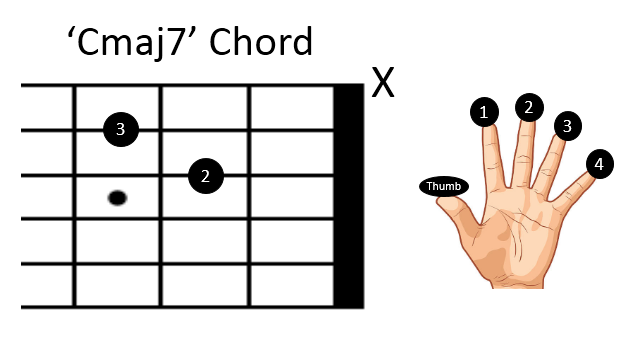
🎸 Cmaj7 Guitar Chord Finger Position
Finger Placement (Easy/Open Position):
- Ring Finger (3): 3rd fret, A string (5th string)
- Middle Finger (2): 2nd fret, D string (4th string)
- Index Finger (1): 1st fret, B string (2nd string)
Strum: From the A string (5th string) down to the high E string (1st string). Avoid the low E string.
✅ Tips for Playing Cmaj7 Cleanly
1. Keep Your Fingers Curved
Use your fingertips and keep your fingers arched so they don’t accidentally mute the open G or high E strings.
2. Place Fingers Close to the Frets
Position each finger just behind its fret (not on top of it) for a cleaner sound with less effort.
3. Let the Open Strings Ring
The open G and high E strings are part of the Cmaj7 chord. Make sure they ring out clearly.
4. Avoid the Low E String
Start your strum from the A string. If you accidentally hit the low E string, lightly touch it with your ring finger to mute it.
5. Relax Your Fretting Hand
Press only hard enough to produce a clean note. Excess pressure can cause hand fatigue.
6. Check Each String Individually
Play each string one at a time. If a note buzzes or sounds muted, adjust your finger angle or pressure.
7. Practice Smooth Chord Changes
Cmaj7 is commonly used with:
- Am
- Em
- G
- Fmaj7
- C
Practice switching between these chords slowly before increasing your speed.
8. Keep Your Thumb Behind the Neck
Place your thumb roughly in the middle of the back of the guitar neck. This improves finger reach and control.
9. Strum Evenly
Use slow, consistent downstrokes at first. Once every note sounds clear, add upstrokes and different strumming patterns.
🎵 Common Chord Progressions Using Cmaj7
- Cmaj7 → Am → Fmaj7 → G
- Cmaj7 → Em → Am → Fmaj7
- G → Cmaj7 → D → Em
- Am → Fmaj7 → Cmaj7 → G
These progressions are widely used in pop, acoustic, indie, jazz, worship, R&B, and soft rock music.
💡 Beginner Practice Tip
Spend 5–10 minutes daily switching between C, Cmaj7, Am, and Fmaj7. Since Cmaj7 differs from a C major chord by lifting just one finger, it’s an excellent exercise for improving chord transitions and finger independence.