
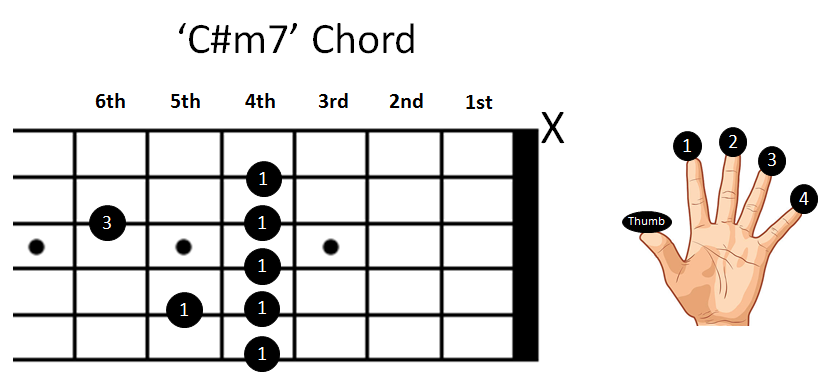
Finger placement:
- Index finger: Barre 5 strings at the 4th fret
- Ring finger: 4th string, 6th fret
- Middle finger: 2nd string, 5th fret
- Avoid strumming the 6th string (low E string) when playing this chord.
💡 Tips for Playing C#m7 Clearly
1. Don’t press too hard
A common beginner mistake is squeezing the neck too tightly. Apply only enough pressure to make each note ring clearly.
2. Position your thumb correctly
Keep your thumb roughly behind the neck rather than wrapping it too far around the top. This makes the barre easier.
3. Keep your index finger straight
For the barre, try placing the index finger slightly on its side rather than directly on the softest part of the fingertip.
4. Check every string individually
Before strumming, pick each string one at a time. If one sounds muted or buzzy, adjust your finger position.
5. Practice the chord change
Try changing between C#m, C#m7, A, E and B. These combinations are particularly useful for developing smooth chord transitions.
🎯 Beginner Practice Exercise
Start slowly:
C#m7 → A → E → B
Play each chord for 4 beats and repeat.
Once you can change between the chords comfortably, use a metronome and gradually increase the tempo.
C#m7 Chord Formula
For students interested in guitar theory:
C#m7 = C# – E – G# – B
The chord contains:
- C# – Root
- E – Minor 3rd
- G# – Perfect 5th
- B – Minor 7th
This is what gives C#m7 its characteristic minor, warm and slightly jazzy sound.
🎸 C#m7 vs C#m
The difference is the 7th note.
C#m: C# – E – G#
C#m7: C# – E – G# – B
Adding the B gives C#m7 a softer and more sophisticated sound compared with the standard C#m chord.
⭐ Final Tip
If you’re struggling with the barre, don’t try to play the chord quickly. Place your fingers slowly, check each string, strum, release, and repeat. Consistent practice will gradually build the finger strength and coordination needed to play C#m7 cleanly.