
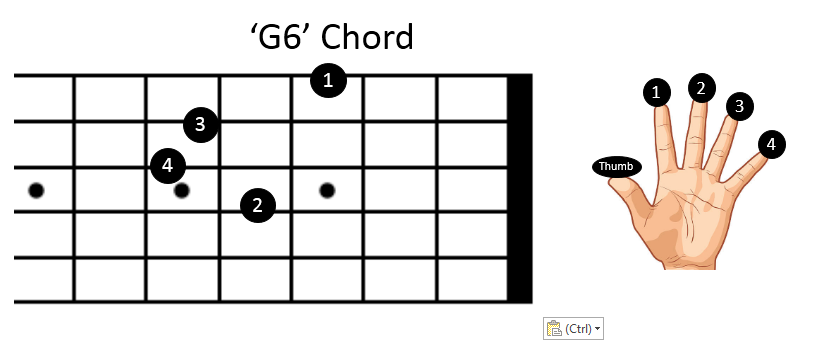
Finger Position
- Index finger → 3rd fret on low E string
- Ring finger → 5th fret on A string
- Little finger → 5th fret on D string
- Middle finger → 4th fret on G string
- Rest strings are open
Tips to Play G6 Smoothly
1. Curve Your Fingers
Keep fingers curved so they don’t mute nearby open strings.
Open strings are what give G6 its beautiful airy sound.
2. Thumb Placement
Place your thumb behind the neck (not over it initially).
This helps your fingers stretch comfortably.
3. Strum Slowly First
Start from the low E string and strum all 6 strings gently.
4. Listen for Open Strings
The open B and high E strings should ring clearly.
If they sound muted:
- lift your palm slightly
- arch fingers more
5. Transition Practice
Practice switching:
- G → G6
- Em → G6
- C → G6
These are very common progressions.
Common Mistakes
- Muting open strings accidentally
- Pressing too hard
- Letting finger touch neighboring strings
- Strumming too aggressively (G6 sounds better softer)
Sound & Usage
The G6 chord gives:
- dreamy sound
- warm acoustic vibe
- light jazz feel
- emotional/colorful harmony
You’ll hear similar sounds in:
- acoustic pop
- indie music
- Bollywood unplugged songs
- fingerstyle guitar pieces
Practice Exercise
Try this slow pattern:
G → G6 → Em → CCount:
1   2   3   4
Down Down Up Down
This helps your hand memorize the shape naturally.